Last reviewed:
DS-160 Photo Requirements
A DS-160 photo must be a square colour JPEG between 600 × 600 and 1200 × 1200 pixels, under 240 KB, taken within the last 6 months against a plain white or off-white background, with no glasses and a neutral expression. Your head must fill 50–69% of the image height.
The printed equivalent some posts request at the interview is 2 × 2 inches (51 × 51 mm). Full specifications and the common rejection reasons are below.
Check your file before uploading: Use the free, private free DS-160 photo tool and checker to verify the JPEG format, square dimensions, pixel range, and file size. The photo stays on your device.
In depth
- Exact photo size in pixels and inches
- Background color and lighting rules
- Photo rules for babies and infants
Photo Specifications
Your digital photograph must meet the following specifications:
- Format: JPEG (.jpg) file format
- Dimensions: Square (1:1 aspect ratio)
- Size: Minimum 600 x 600 pixels, maximum 1200 x 1200 pixels
- File size: Less than 240 KB
- Background: Plain white or off-white
- Color: Color photograph (not black and white)
- Recency: Taken within the last 6 months to reflect your current appearance
Composition Requirements
The photo must be properly composed with the following characteristics:
- Head position: Facing the camera directly with full face visible
- Head size: Your head must be between 50% and 69% of the image's total height
- Eye level: Eyes open and clearly visible
- Eye position: Between 56% and 69% from the bottom of the image
- Facial expression: Neutral expression or natural smile
- Eyeglasses: Not permitted except in rare cases when they cannot be removed for medical reasons; a signed statement from a medical professional may be required
- Head coverings: Not permitted except for religious purposes, and must not obscure facial features
DS-160 photo size at a glance
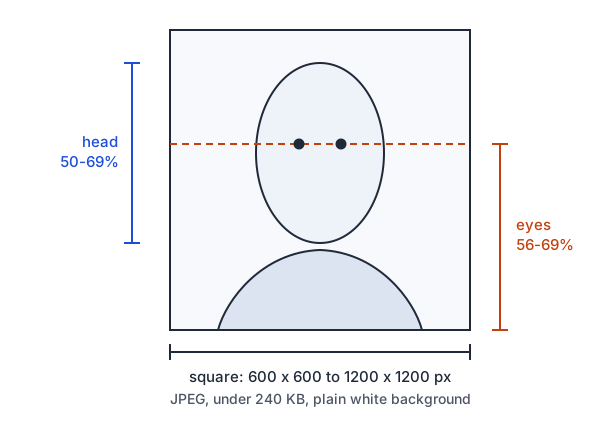
The two proportions people fail are in that diagram: head height and eye position. A photo can be the right pixel size and still be rejected because the face is too small in the frame or sits too low.
The digital file you upload to the DS-160 and the printed photo some posts ask for at the interview follow different specifications:
| Requirement | Digital (DS-160 upload) | Printed (interview backup) |
|---|---|---|
| Size | 600 × 600 to 1200 × 1200 px, square | 2 × 2 inches (51 × 51 mm) |
| Format | JPEG (.jpg), colour | Colour print on photo paper |
| File size | Under 240 KB | — |
| Head height | 50–69% of image height | 1 to 1⅜ inches (25–35 mm), chin to crown |
| Eye position | 56–69% from the bottom | 1⅛ to 1⅜ inches (28–35 mm) from the bottom |
| Background | Plain white or off-white | Plain white or off-white |
Passport photos from other countries are often not interchangeable: the common 35 × 45 mm format used across Europe and Asia is rectangular and too small for a U.S. visa photo. Have a 51 × 51 mm square photo made instead, or create one with the free photo tool.
Common Mistakes to Avoid
- Using photos with shadows on the face or background
- Wearing eyeglasses without a documented medical exception
- Having red-eye effect
- Using photos with poor lighting (too dark or too bright)
- Submitting photos with digital alterations or filters
- Including other people or objects in the photo
- Using photos where your face is not centered
Tips for Taking a Compliant Photo
- Proper lighting: Use even, diffused lighting to avoid shadows on your face or background
- Distance: Stand about 4 feet (1.2 meters) from the camera
- Attire: Wear normal attire (no uniforms, unless religious attire worn daily)
- Accessories: Avoid large jewelry or hair accessories that obscure the face
- Children photos: For infants, place them on a white sheet with nothing else in the frame
Photo Validation Tool
Check your photo against every requirement on this page with the free DS-160 photo tool. It reads the file's real dimensions and size, measures head height and eye position against the ranges above, looks at the background, and tells you which specific item fails and how to fix it. It runs entirely in your browser — the image is never uploaded anywhere.
The Department of State also publishes an official Photo Tool. It is a cropper: it resizes and crops an image to the right shape, but it does not tell you whether the photo will be accepted. The two are complementary — check first, crop second.
Neither guarantees acceptance. A consular officer can still reject a photo that passes any automated check.
What Happens If Your Photo Is Rejected?
If the confirmation page displays an X where the photo should be, the upload failed. Follow the instructions for your application location and bring a compliant printed photo to the interview. A consular officer can still reject a photo that does not meet the requirements.
Frequently asked photo questions
Can I wear glasses in my DS-160 photo?
No. Eyeglasses have not been allowed in U.S. visa photos since November 2016, except for rare medical reasons documented by a signed doctor's statement. Take them off — including clear lenses.
What size does the DS-160 digital photo need to be?
A square image between 600×600 and 1200×1200 pixels, in JPEG format, 240 KB or smaller. Your head should take up 50–69% of the image height. The photo tool checks and resizes automatically.
Can I take the photo myself with my phone?
Yes — a phone photo is acceptable if it meets every requirement: plain white or off-white background, even lighting with no shadows, direct face-on angle, neutral expression, and no filters or edits to your features. Arm's-length selfies are usually rejected for angle and distortion; have someone else take it or use a tripod.
How recent does the photo have to be?
Taken within the last 6 months and reflecting your current appearance. Reusing the photo from a previous visa application older than that — or one used for a prior visa — commonly causes rejection.
Can I smile in the photo?
A neutral expression is safest. A slight, natural closed-mouth smile is tolerated, but a wide smile that changes your features can be rejected.
Can I wear a hijab or other religious head covering?
Yes — head coverings worn daily for religious reasons are allowed, as long as your full face is visible from the bottom of the chin to the forehead, with no shadows on the face.
Can I have a beard or facial hair?
Yes. There is no rule against facial hair — the requirement is that the photo shows your current appearance. If you shave a full beard off shortly after the photo is taken, retake it; an officer comparing the photo to the person in front of them is the point of the rule.
Can I wear a hat or cap?
No, unless it is a head covering worn daily for religious reasons — the same exception that applies to a hijab or turban. A baseball cap, beanie or fashion hat has to come off, and your full face must be visible from the bottom of the chin to the top of the forehead.
Can I wear jewellery or makeup?
Both are fine as long as they do not obscure your face or change how you look. Everyday makeup is not a problem. Large earrings or a piercing are acceptable if they do not cast shadows across the face or hide part of it. What gets rejected is anything that makes the photo a poor match for you in person.
Can I wear headphones or a hearing aid?
Headphones and wireless hands-free devices are not allowed and must be removed. Hearing aids, cochlear implants and similar medical devices are allowed and should be left on if you wear them daily — the same logic as the religious head covering: the photo should look like you normally do.
Can I wear a uniform in the photo?
No. Uniforms and camouflage-patterned clothing are not accepted, with the single exception of religious attire that you wear every day. Ordinary everyday clothes are what you want.
What should babies and children do about the eyes-open rule?
Infants may have eyes partially open or closed and a not-perfectly-neutral expression — requirements are relaxed for them. Lay the baby on a white sheet and photograph from above; no hands or objects may appear in the frame.
Taking a few minutes to ensure your photo meets all requirements can save you significant time and prevent potential delays in your visa application process.
Not started the form yet?
The photo is uploaded near the end of the application. For an overview of the whole thing first, see what the DS-160 form is.